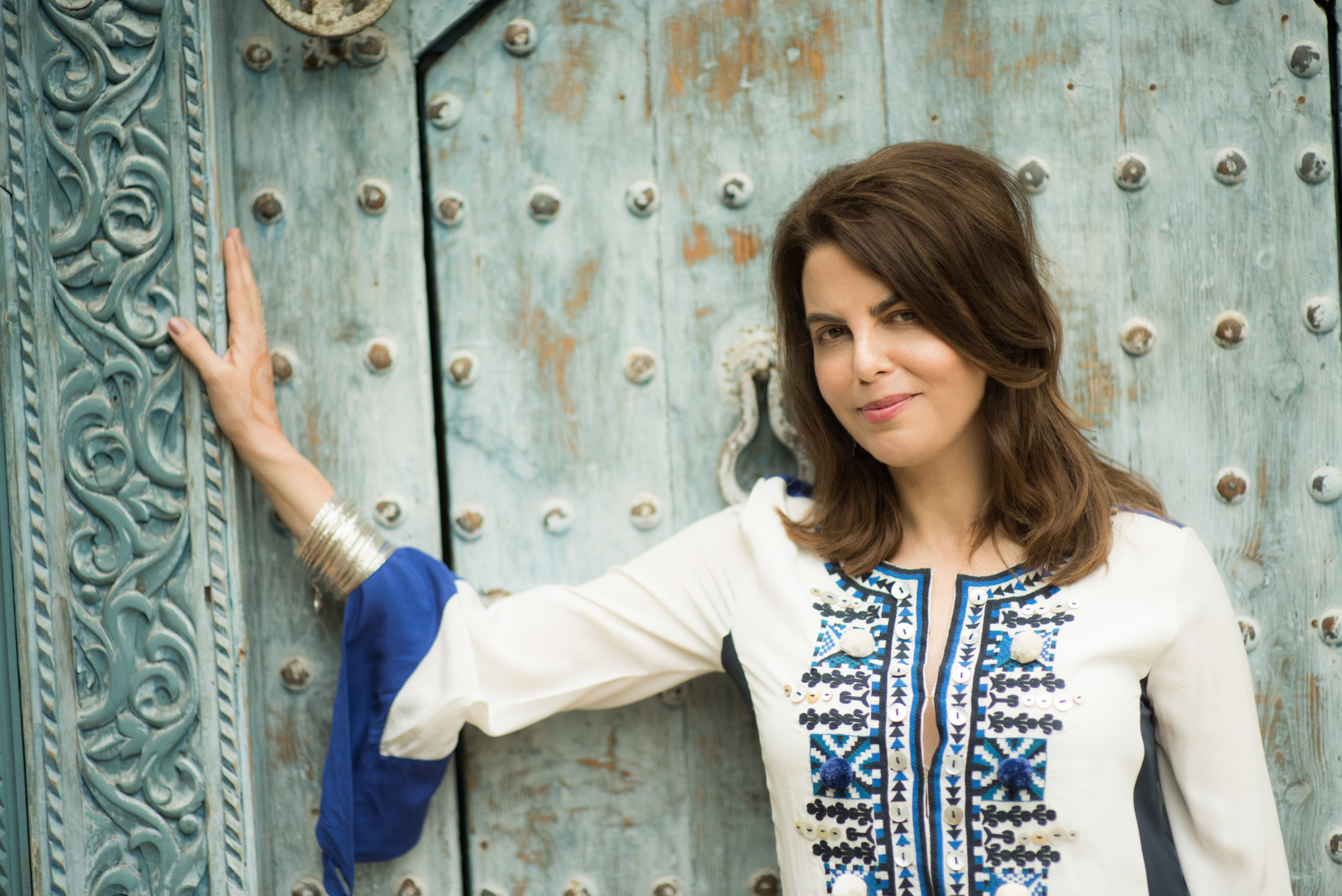
In The Workshop With… Maryam Montague
“BE GOOD, MAKE GOOD, DO GOOD.”
In the ancient city of Marrakesh lives a remarkable woman, the doyenne of “tribal chic.” Maryam Montague wears multiple hats… social entrepreneur and humanitarian, feminist, hotelier, traveler, collector, blogger, and author of “My Marrakesh,” a fabulous design book. Born in Egypt to an Iranian mother and American father, she was raised in Tunisia and then New York. After obtaining her master’s degree in international affairs she spent many years working for NGO’s abroad.
She met her future husband, architect Chris Redecke, in Nepal and, after marrying, they actually moved there together. After a stint in Namibia, they took the opportunity to move to Morocco, settling in Marrakesh where, after starting and raising a family and launching their two children to university in different countries, they still remain, nearly 20 years later.
Maryam’s mantra is “Be good, make good, do good.” I am truly inspired by her passions and her ability to juggle all that she does, as well as the fact that she lives by this mantra in all facets of her life. I knew she was the one I wanted to interview in this issue of INSPIRED, and I was thrilled when she agreed to squeeze me into her extremely busy schedule.
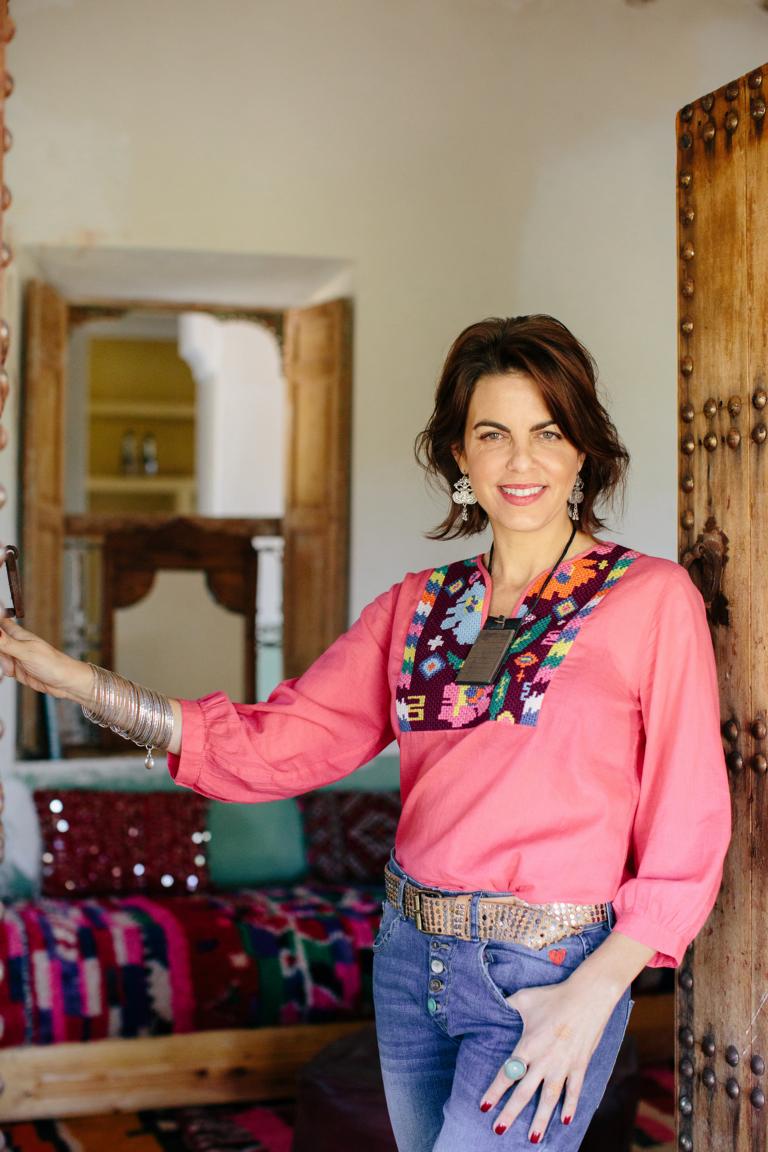
It was a delight to speak with Maryam and learn about her fascinating life and all the various pots on the fire she somehow manages to stir. She was so generous with her time, and we had a long, wonderful conversation in which she shared a WEALTH of insight and information. It was really challenging for me to take 32 pages of our transcribed interview and pare it down to this! She is passionate about what she does and is truly INSPIRING!!
I divided this interview into 3 facets of Maryam’s life… her humanitarian work (she is Founder and Executive Director of Project Soar), her boutique hotel, Peacock Pavilions, and her passion for design and Morocco. She is the author of the beautiful book Marrakesh By Design and curates a beautiful selection of Moroccan homewares and accessories in her online M. Montague Souk.
What brought you to Morocco nearly 20 years ago and inspired you to put down roots in Marrakesh?
Most people are born into their homes and some people choose them, and so that was really my case with Morocco. I just found a place that I felt really married the cultures that I had grown up with — my Persian culture, as well as more interesting contemporary aspects, because of Morocco’s colonial history and its proximity to Europe. It’s been a really surprisingly wonderful place to raise a family and to set up a life that’s a little more adventurous perhaps than the typical.
HUMANITARIAN
You are a self-described social entrepreneur. How did you become involved in humanitarian work and what types of projects do you focus on in Morocco as well as Africa/elsewhere as a whole?
My dad is also in humanitarian aid and ran the Egypt office of CARE. We grew up in a family of service, being a very important value for us. My dad would take us with him when he went on assignment during the summers, and I just thought the world was such an amazing place. I was really determined to try to find a way to be able to make some kind of social impact and to be able to travel. So I set my path that way, deciding to study international relations and earn a master’s degree in International Affairs. I went on to work for an international NGO where I was for many years before I became a management consultant.
You founded your nonprofit organization, Project Soar, to empower girls in 2013. Tell me a bit about it and why you decide to spearhead this project.
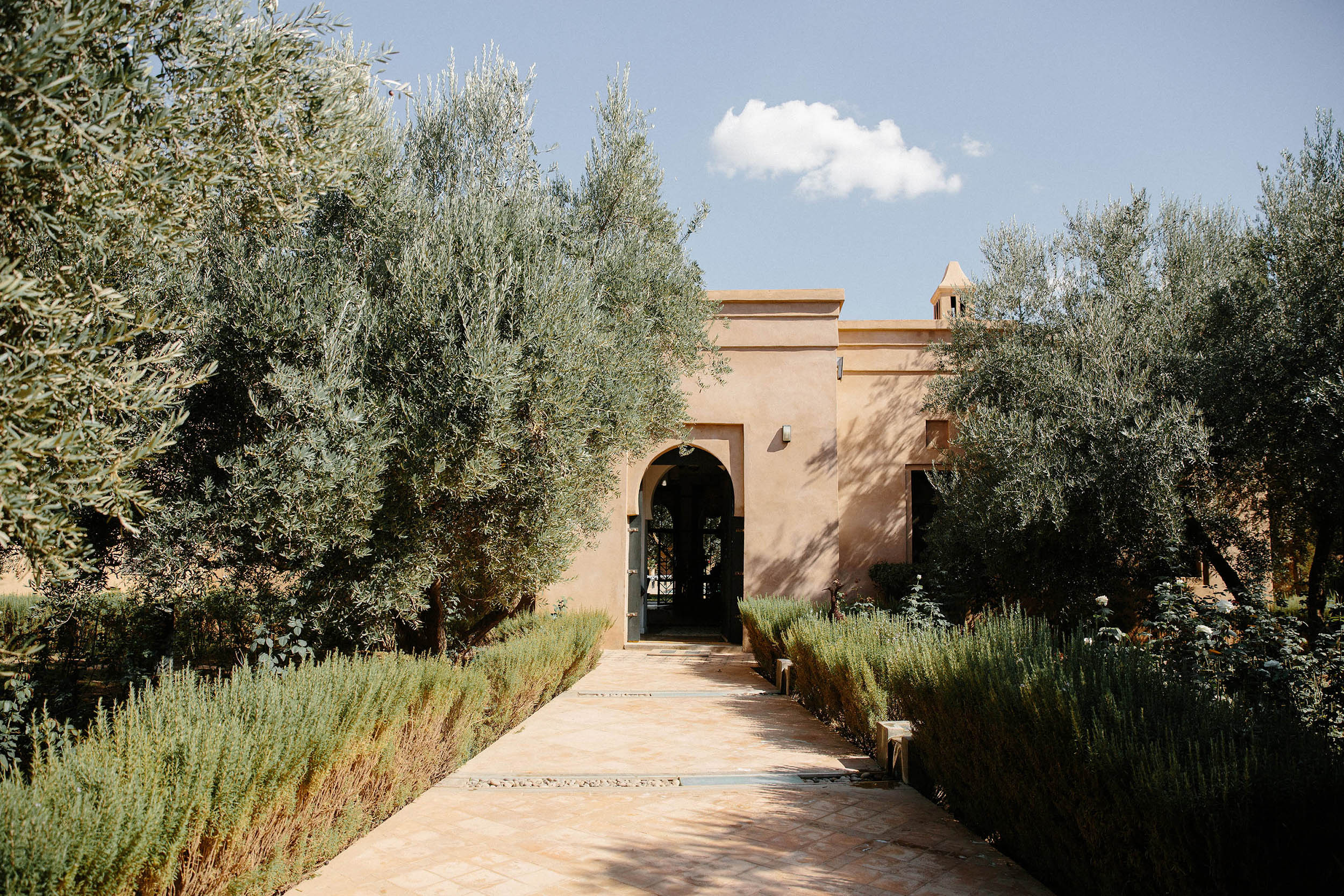
Because my background is in humanitarian aid, that’s always been a very important part of everything that I do. When we decided to move to Marrakesh, we wanted to build a place of our own. Originally, we were looking to renovate a riad. Ultimately, we decided that we wanted to build our own place. At that time, I was working a lot in war zones, and I just felt like as much as I love Marrakesh, the city is so bustling, I felt like I needed someplace that was a little quieter, that was more of a sanctuary, and I really wanted to live on an olive grove. We found this little grove, and when we went to buy it, the City of Marrakesh said that if we wanted to buy a piece of land that was that size, we would need to have an investment project.
So we kind of looked at each other and I said, “I’m a humanitarian aid worker… what are we going to do?” And so we decided that we would build Marrakesh’s “Do Good” hotel and that we would invest what we made into the cause, and we decided that our main interest really was teen girls. So that’s how Project Soar was born.
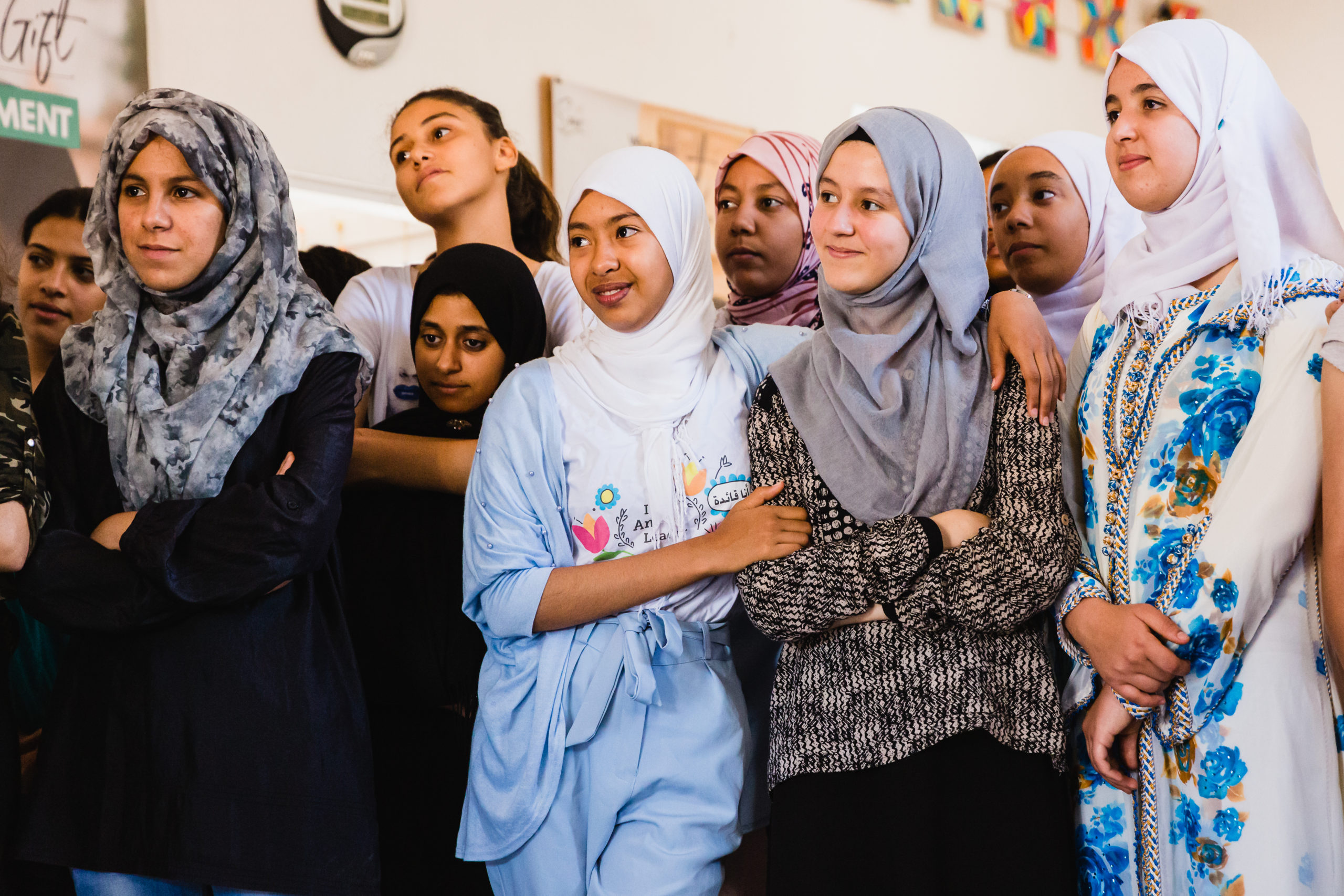
What is unique about the structure that makes Project Soar effective/successful?
We created a framework, which is called Project Soar-in-a-box, which is our scalable system, and contains all the tools that you need to empower a squad of 20 teen girls. We’re currently in 48 locations in Morocco, we’ve provided 120,000 hours of empowerment, we’ve trained 174 women facilitators. We’ve now expanded to Uganda and we’re in negotiations right now to expand further in Africa, and so I think that really building to scale has been important for us.
The Project Soar girl has a pretty unique profile so on average, she’s living on less than a dollar a day, so she comes from a really marginalized background. These girls are on this generational cusp where there’s so much potential for them, and we really just want to help partner with the families to invest in these girls, so they are able to really move ahead. We believe that this is not only a question of social justice for girls that shouldn’t be held back, but it is a real way out of poverty. So rather than doing for girls, we are really investing in girls so they can chart their own paths, and then we have so many more scientists and journalists and mathematicians and business owners, to help build the economy together. So that’s really been our principle at Project Soar — investing in teen girls to be the leaders of today and tomorrow.
PEACOCK PAVILIONS
You and your architect husband designed and built a stylish home and boutique hotel from scratch, comprised of three pavilions on an olive grove on the outskirts of Marrakesh. What an ambitious undertaking in a foreign country! Can you tell me more about that?
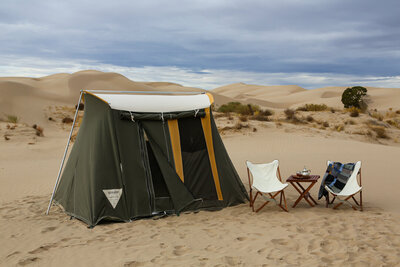
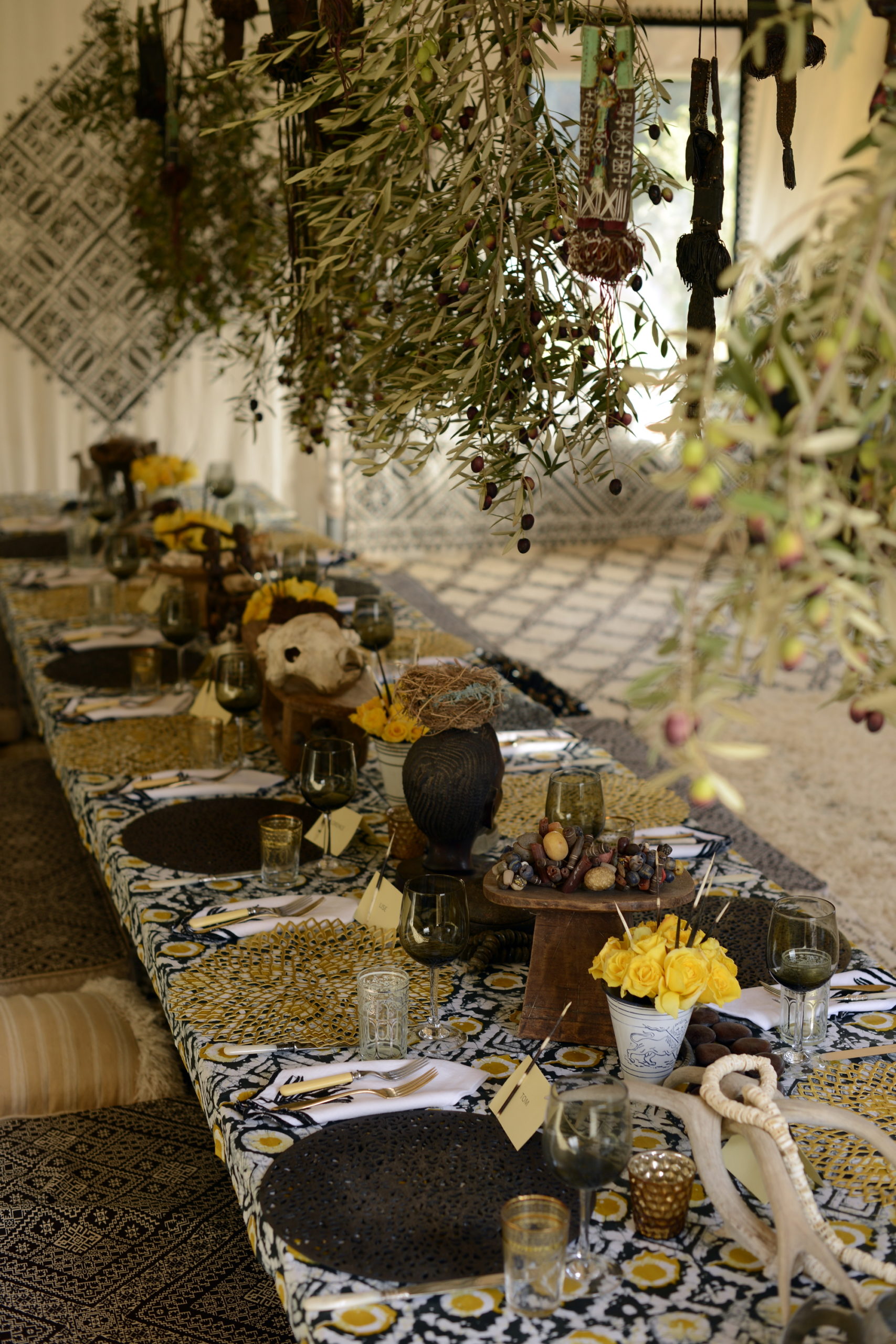
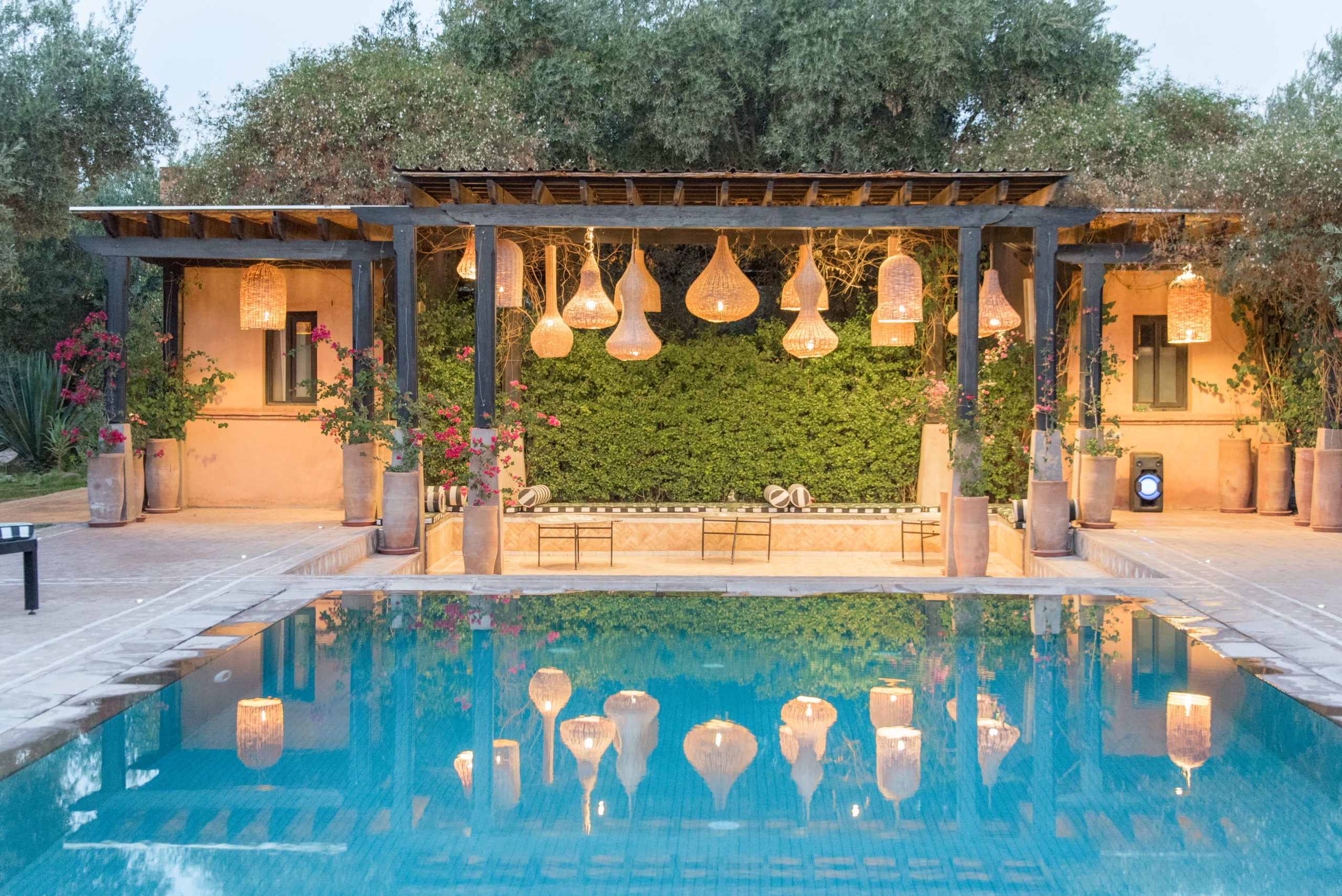
It’s a hand-built property, an artisanal build, so it was a slow, intense build with a team of about 25 people who built it over four years. My husband is an architect, so he designed it and actually became the foreman on the job. There is a dining tent, yoga pavilion, an outdoor cinema, a gym, a little secret garden (perfect for ceremonies), an outdoor dining space with walls made of hedges… there are quite a few structures on the property. We designed it to really respect the Moroccan architecture, but kind of pare it down a little bit, so it’s just a bit cleaner and really a place to showcase some of our collections. We collect all kinds of things, and we really wanted to have the possibility of showcasing them, kind of like one big cabinet of curiosities.
Oooh, what are some of the items you collect?
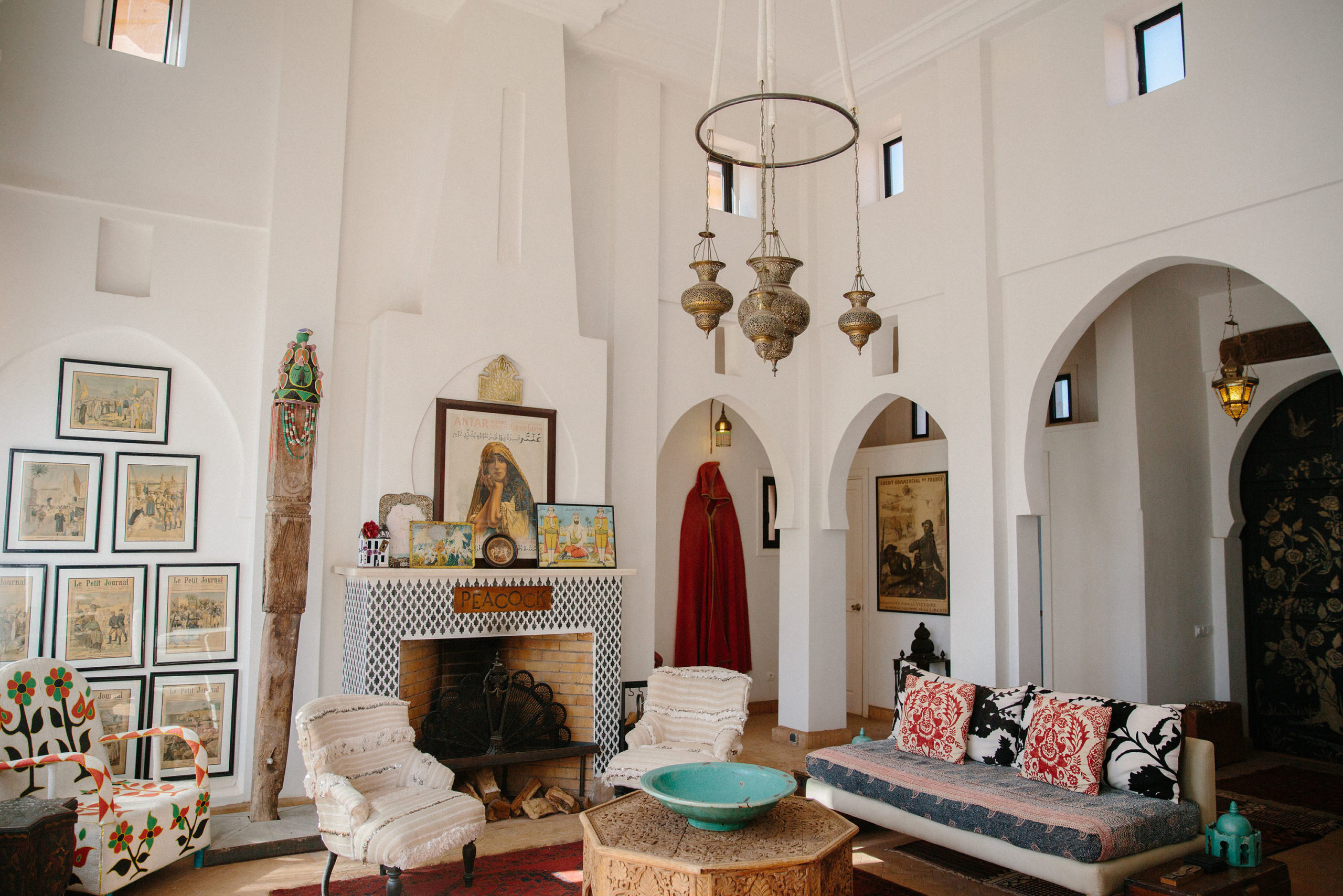
MM: We collect a lot of symbols and talismans, amulets from everywhere. A lot of hands, a lot of eyes, a lot of bones, all kinds of skulls. I collect all kinds of nests and pods, as I’m really fascinated by nature. We collect everything from tribal jewelry to Afghan hats and we have a very large embroidery and textile collection. It’s very rare that I buy new things. I’m usually on the road for work so much, and I’m always looking for things that are related to magic and the supernatural. I also love religious icons. So everything that contains some sort of leap of faith really intrigues me.
When we were moving around, I was working with the Burmese government in exile in India, but I was living in Nepal. When I traveled to India, I would buy Indian doors, antiques, tables made out of horse carts, and I would ship them back to a storage container in the US. I told my husband, “One day, we will have a home and I will bring all of this back and I will use it.” And that is what we did. It’s all in our place, and that’s a good thing about having a small hotel. If you look at it, it doesn’t really look like a hotel, it looks just like your cool friend’s house filled with unusual artifacts. And I think that’s what makes it kind of special here. Morocco is so known for its incredible design, but we didn’t want it to look like one big swoop through the souks, we really wanted it to be more of a visual diary of our travels and for it to be meaningful in terms of our own life story.
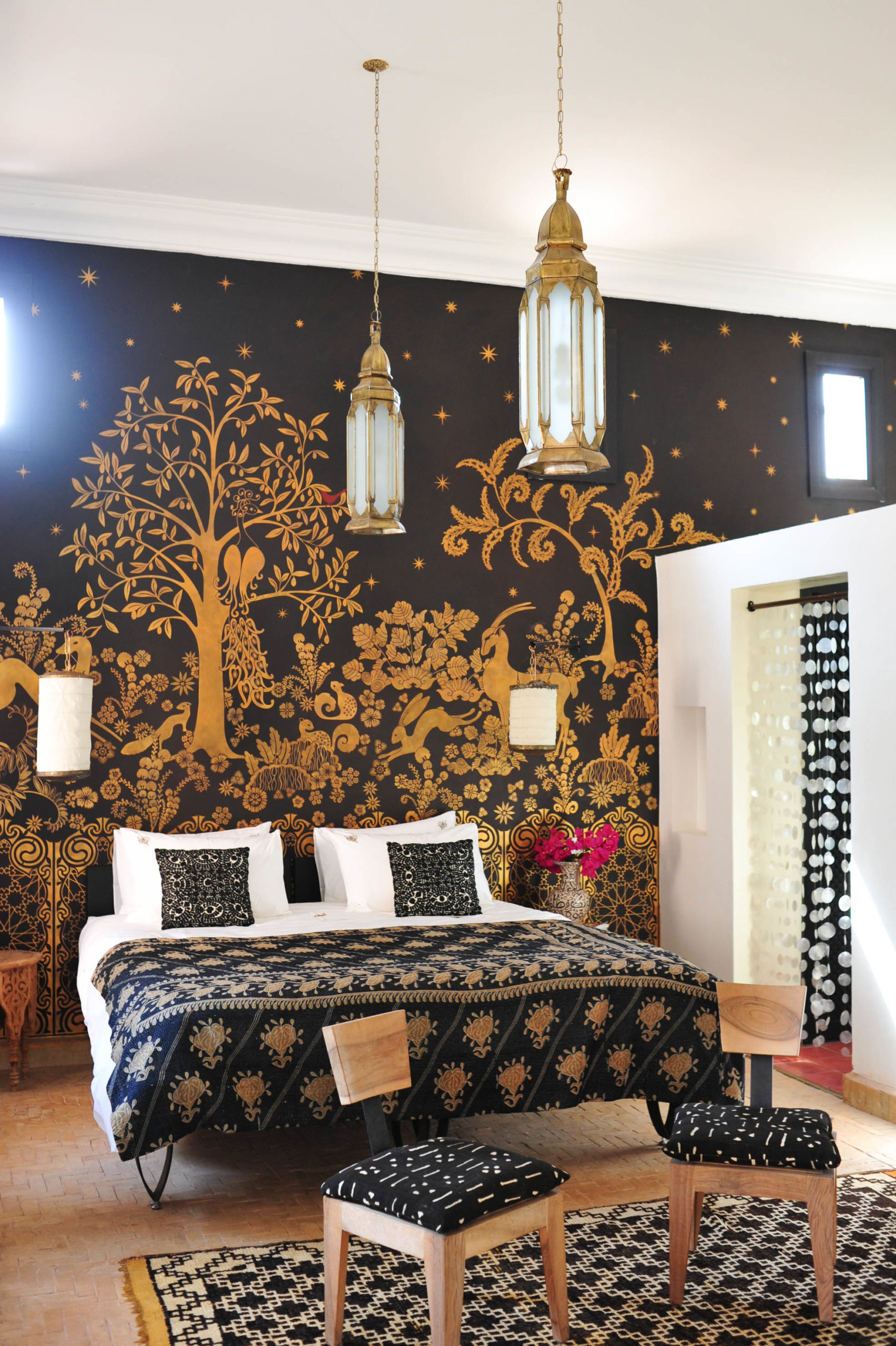
Tell me about how you approached the design of your home and the pavilions
I didn’t start with the structure and then think, “Okay, what do I need for this place?” I always believe that if you find beautiful things, you will find a place for them, and so that’s what we did with our place. What was important to us is that with the Pavilions, rather than a guest house where you have rooms one next to another, we would have these different spaces, which would have a lot of possibilities for living in them.
We have multiple domes on the property, so you really have that lofty feeling when your ceiling is 20 feet high. We did a lot of art on the ceilings, which is common in Morocco because the most beautiful surface should always be the one that’s closest to God. We actually really stripped back the color, so that with so much going on, there is still have a feeling of serenity within the space and you can really see the art. Of course, Morocco is so well known for all of its vibrant colors and all of its amazing patterns, but they do require some thinking, so it doesn’t feel chaotic. It’s one thing to go and see it in a beautiful palace, but to live with it, you just have to be a little judicious in the use.
What do you love most about your home and Peacock Pavilions?
I would say I love my gardens. That is so important to me. And it’s been so important during the pandemic for me to be able to really be in nature. We are in an olive grove where we have about 200 olive trees, as well as many other kinds of trees that we planted. We planted hundreds of rose bushes, jasmine and bougainvillea. It’s so wonderful to see it change, and come alive. One of my great pleasures is to get up very early in the morning and go out and prune the roses. It’s my own form of walking meditation.
What do you find most fulfilling about owning/running Peacock Pavilions?
It’s definitely our clients. We have the best clients. I think the people who are attracted to the property are either interested in design, which we’re passionate about, or they’re really interested in wellness, which we’re also passionate about. But we really wanted to be very culture forward. We really spent time experimenting with the design culture and the food culture, we do Moroccan wine tastings and we help plan every facet of a guest’s trip. So when they leave, they really feel full. I want people to really appreciate the complexity of this country and to be able to share that.
MOROCCAN DESIGN
You clearly have a designer’s eye, the innate ability to look at something and see what it can become. You wrote and photographed a gorgeous book, Marrakesh by Design, which is such a feast for the eyes and certainly inspires wanderlust! How did you hone your design aesthetic?
I grew up with parents who are very passionate about global design. My parents traveled a great deal and collected things. I think for me that always felt really curious and fascinating and inspired my own aesthetic. I think in general, because I work on social justice issues, you can imagine working on prisoner rights and human rights in general that, my day job can be really intense and sometimes really tough. And so I started a blog many years ago that really was about Moroccan design and my own kind of quest for beauty. I think that was a way to kind of heal myself from working in the field of human rights. I wanted very deliberately not to talk about my work.
I really wanted to learn more about Moroccan design. So I set out to learn more and was fortunate enough to have Artisan Books reach out to me about doing a book on Moroccan design.
I know you love finding and developing relationships with artisans. How has that influenced your passion and appreciation for Moroccan design, art and craft?
I spent afternoons with the Malaams (masters), learning about their craft, how they worked and what principles were important to them. That was a really lovely extension of what I was learning. I think more than anything, I’m a student of design. I’m still learning so much about Moroccan design and I always seek that everywhere I go, whether it’s Uganda or Hong Kong or Rwanda. On my travels, I’m always trying to get to the source of the design and meet with the makers so I can learn. I feel like when I buy something, I really want to understand what it is, not only what its function is, but where it came from and why it is that way.
What is it about Moroccan design that you think is attractive to other parts of the world?
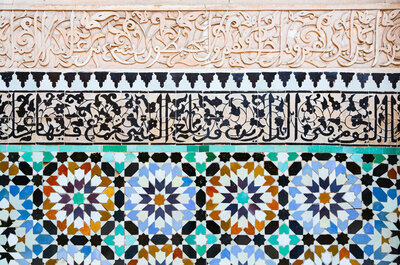
I think Moroccan design is all about these incredible architectural shapes, these very saturated colors, these complex patterns. It’s really an iconic design. I think it’s a place that really has a culture unto itself. It’s not aspiring to be like another culture, it’s aspiring to be more of itself.
Your brand is socially responsible and your mantra is, “We believe that all products and experiences should be good, make good, and do good.” What inspires you to keep yourself aligned to these values?
I think one of the reasons why it continues to inspire me is that I live so close to my cause.
It’s not only for the good that you do, it’s how you feel about yourself. I knew growing up in a family of service, it was very important to us, but I loved the way it made me feel. I think it’s a very beautiful selfish thing that one can do, to do a little good.
With so many passions and interests, how do you find balance in life?
I’m trying to live more of an essentialist lifestyle, which means really trying to focus on the things that feel most essential to you. So that could be your family, your friends, or your cause. I use a lot of techniques to kind of try to keep me on track, so I have a series of rituals that I’ve been practicing for years. I’ve been meditating daily for over 30 years. I use the Pomodoro Technique, which is a time management technique. I also listen to the Brain.fm app, which is all about improving your neural pathways, so you can really get into a flow state.
I really swear by the Lion’s Mane mushroom elixirs, that really help improve your ability to focus. And I just try not to take on too much because there are so many things I’m already invested in. The other thing that’s been enormously helpful for me is I’ve been working with a life coach for years.

Maryam has her own online boutique, the M Montague Souk, where a percentage of each purchase goes to Project Soar. From vintage rugs and wedding blankets to cushions and brass or nickel jewelry-quality hooks, which are really lovely to hang your towels on.
Learn more about Project Soar here
Stay at Peacock Pavilions
Follow Maryam on Instagram
Maryam’s recommendations
Favorite shops:
Maroc’n Roll – Owned by a former designer for Yves Saint Laurent. Hand-painted bags, very cool things.
Valerie Barkowski – She has such beautiful linens and towels, all of those really kind of pared-down but very high quality everyday luxuries.
Atelier Landon – Frenchwoman Laurence Landon crafts beautiful brass vessels for candles, lighting fixtures and furniture. She does a lot of custom work as well. Her artisans are amazing. I find that I really love what happens when you have a blend between western and Moroccan. There is something new that comes out of that alchemy that is so good, which makes it really livable and easier to incorporate into your home. The new candle series are handmade by Moroccan master artisans. We have many of Laurence’s lights at Peacock Pavilions. Once the candles are burned, you have a gorgeous vessel. The craftsmanship is incredible!
Jewels – An all women atelier (with locations in Marrakesh & Santa Fe), Jewels has created her own technique for beading and her talismans are incredible.
Magic souk/herbal souk – It’s fun to have your own talisman made. You can get a brass amulet and they will put everything in there for you (hair of a lion, bits of ore or minerals) depending on what you’re looking for. Because I’m so passionate about magic, it’s very fun to experience this.
Favorite restaurants
La Mamounia – I love to have a drink in their gardens because it’s just my happy space.
Salt – They will cook good Moroccan food for you to order. It’s a more private experience.
Address: QUARTIER AL MASSAR N°26, Rte de Safi, Marrakech 40100, Morocco
Le Petit Cornichon – For really good French-Moroccan combination food, it’s the kind of place that people linger for hours.
Le Palace – I love to go there for a drink. They usually have a jazz singer. It’s a lounge for grown-ups.
Highly recommended places to visit outside Marrakesh :
Cactus Thiemann – An elaborate cactus garden, the largest in Africa. It’s absolutely incredible (more than 150 varieties of cacti). I’ve been really learning about and loving cactus.
Palm Orchids – My favorite organic nursery. The owner has introduced something like 30,000 species to the country. I just love to go and wander there as a form of meditation.
Oualidia – A little coastal town on a beautiful lagoon, sort of off the beaten path. A great place to go if you’re a foodie, to partake of the freshest oysters and crabs as big as your plate.
Val d’Argan – A vineyard with its own set of wines. I really love food and wine. You’d never know how much wine is produced in Morocco!
IMAGE CREDIT, COVER PHOTO: CHRISTINE JOHNSON